The Words of

Sri Rabbi Mercurius Azulai de la Cruz

initiated in the mysteries of which no one should speak

transmitted and compiled by his faithful and devoted disciple

Herr Angelus Ben David Hamitzri Ben HaShunamit

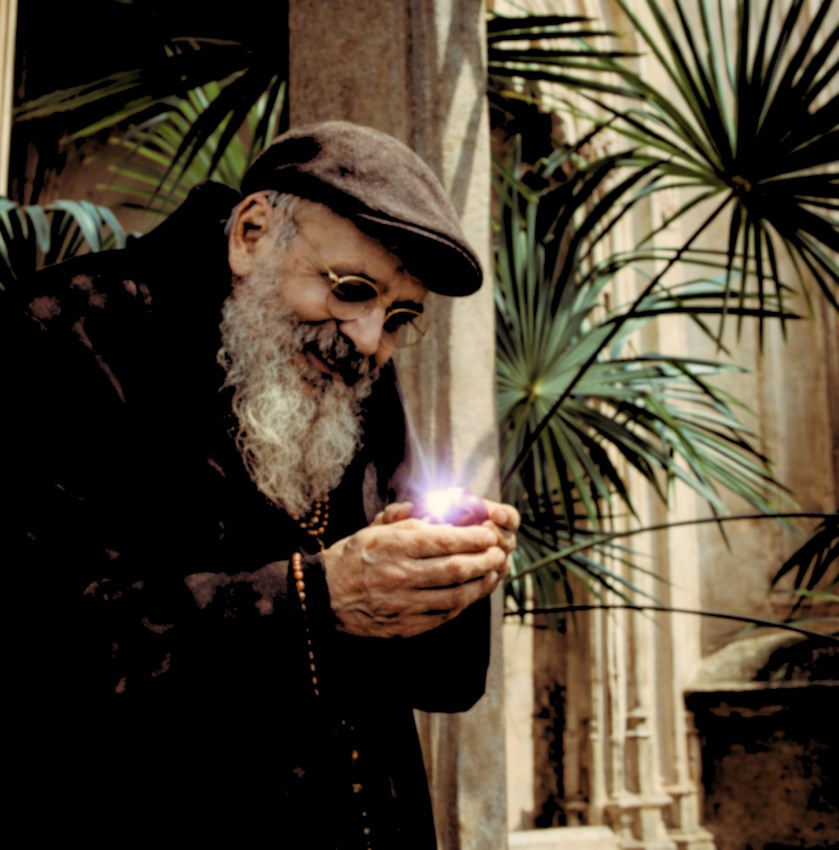
Picture of Our Master taken by Rodolfo Cañas, PhD, on Fall, 1985.

This modest website is a wholehearted—posthumous?—homage offered by his disciples to our beloved master, Sri Rabbi Mercurius Azulai de la Cruz.

Hereby his disciples thought this could be of a great contribution to humanity, and entrusted me with trembling awe with the responsability of gathering his sayings, our testimonies and such writings of his as could be preserved. We’ve considered this work to be but a small grain, perhaps capable of further guiding the path of the sons of our age amid the troubled times through which we find ourselves passing.

Of him very little can be said with certainty. Some say he was a disciple of Sri Rama Maharshi and the Chafetz Haym, others he learned from Mother Theresa of Calcuta, Mahatma Ghandi and Shushani; still some others say he is self-thaught into the mysteries of God and Nature. Some say he was born in India, Spain or Mexico; don’t even ask about his date of birth.

What those of us who knew him can attest is this: his life and teachings inspired us to love more and more freely, to be more flexible and less attached to the labels we regard ourselves to be and to be more open to joy and to be surprised by the unexpected and the unassaible mystery of existence.

With no further ado here we will be presenting his sayings, writings, and our insufficient testimonies that couldn’t make no justice of his greatness and joy, his child-like innocence and curiosity and the seriousness he attended the affairs of love.

Faithful to his spirit and instruction, he enjoined us to articulate what we had learned in our own voice; hence, what follows also gathers fragmentary reflections from those within his circle.

  • Non se fabla assí

    March 17th, 1991. The secrets catacombs of Toledo.

    The master said:

    ¿Quién es el otro para uno?

    Aquel es que puede corresponder como egual en amistad, guardando su otredad.

    En la salud, para uno, quien esto non puede, non es auctoridat de fuera,
    mas ruido de fondo—e quizá uno mesmo

    For our English speaking fellows I managed to translate: “Who is another for oneself? It is that who can correspond as an equal in friendship maintaining his otherness. In health, for oneself, who this cannot do, it’s not an outer authority, but background noise and perhaps also oneself.”

    The master said: No, no. En Sefarad non se fabla assí.